Bool Audio
Clear Wave Unipivot Tonearm
British-made for the Linn LP12, built by hand without compromise
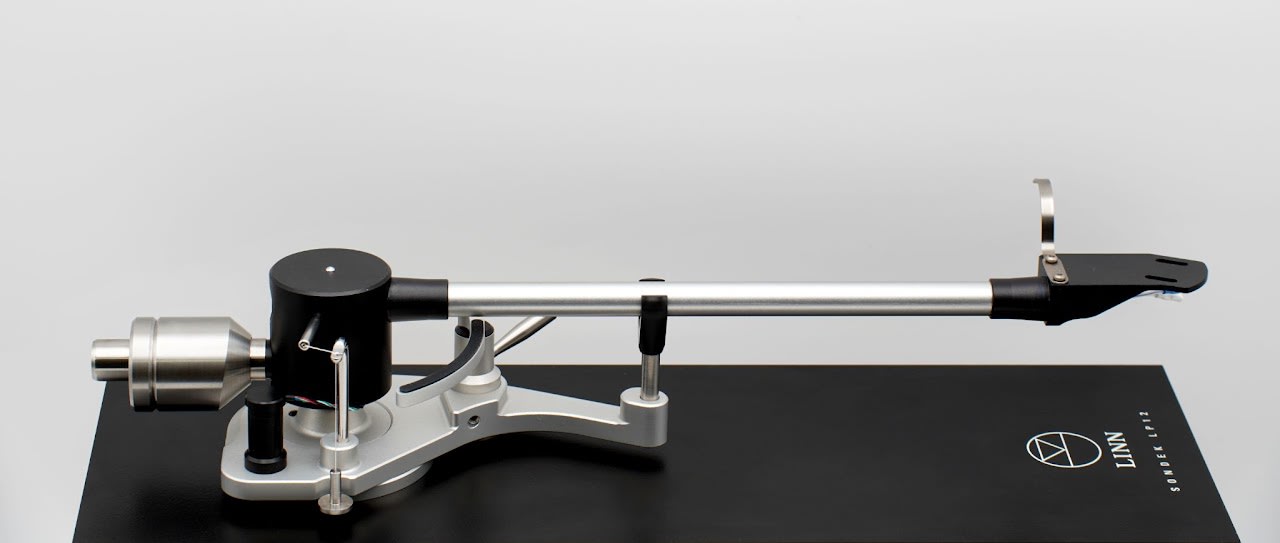
The Clear Wave has been a long time coming. It began with a passion for the Naim Aro and a restored Lenco L75: a father-and-son project built on an old lathe and milling machine, inspired by forum photos and articles, having never even seen a real Aro in person. That first arm proved the concept. But making something we'd be proud to put our name on required a completely different level of precision, so before a single Clear Wave part could be cut, a CNC milling machine had to be designed and built from scratch, a process that took three years of weekends alone.
The Clear Wave draws inspiration from that classic Aro-style unipivot, combined with the advantage of everything that has improved since 1987. CNC machining and CAM software have advanced enormously in that time: tighter tolerances, more complex geometries, greater consistency from part to part. The result is a more practical arm to live with, and a more precisely made one. The quirks owners learned to accept, fussy setup, awkward cueing, the lashed-on bias thread, are gone. It bolts straight to a Linn Sondek LP12 using the standard armboard, so installation takes minutes rather than an afternoon.
In Stock
Currently shipping from stock. Typical dispatch within one week of order confirmation.
Engineering
Sapphire Pivot
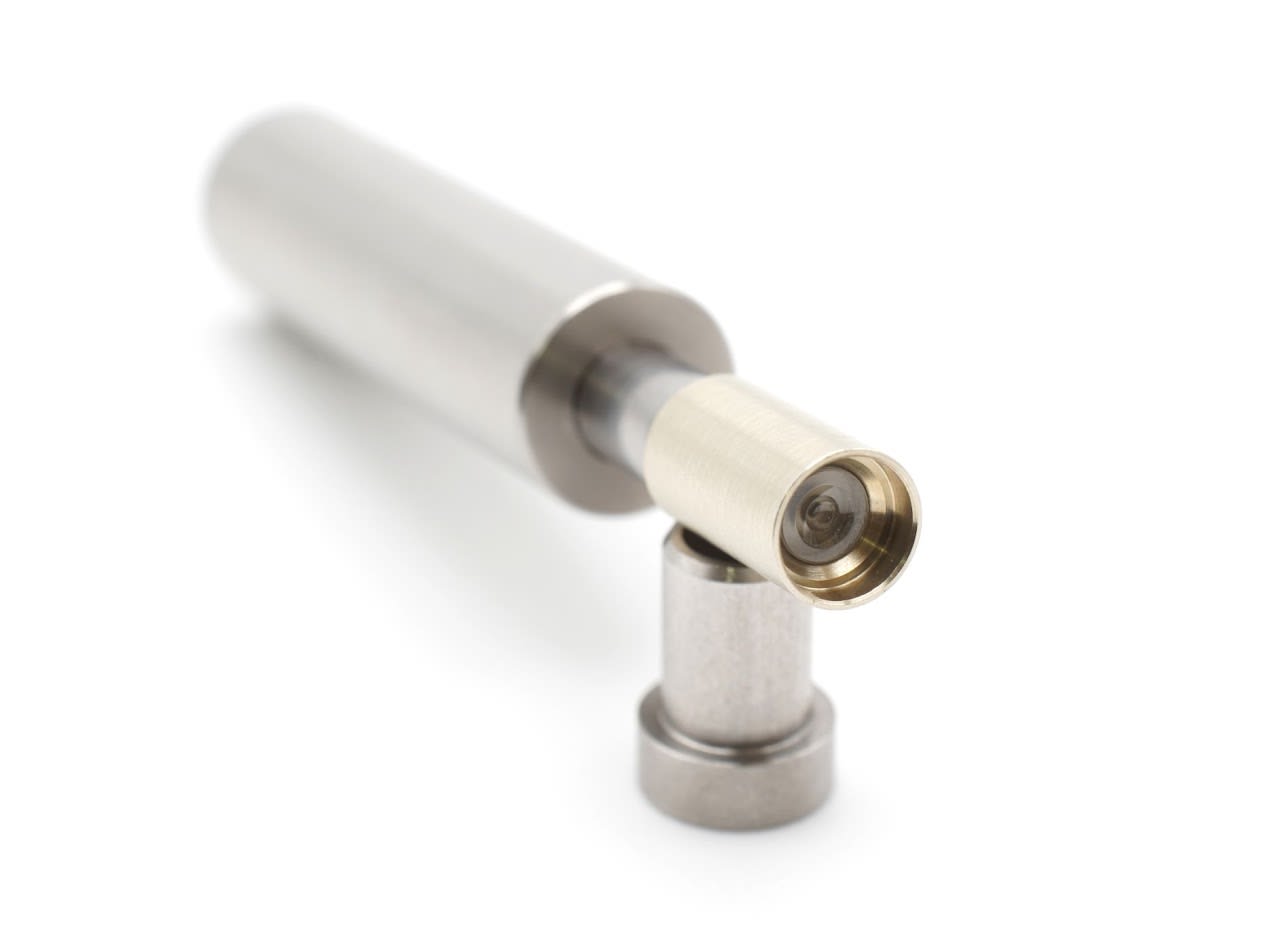
The sapphire double cup bearing is the heart of the unipivot design, inherited directly from the original Naim Aro, which proved beyond doubt that a single point of contact on a sapphire surface produces a freedom of movement that conventional bearings simply cannot match. The Clear Wave honours that original insight, pairing the same bearing principle with modern machining precision.
Nickel Silver Balance Weight
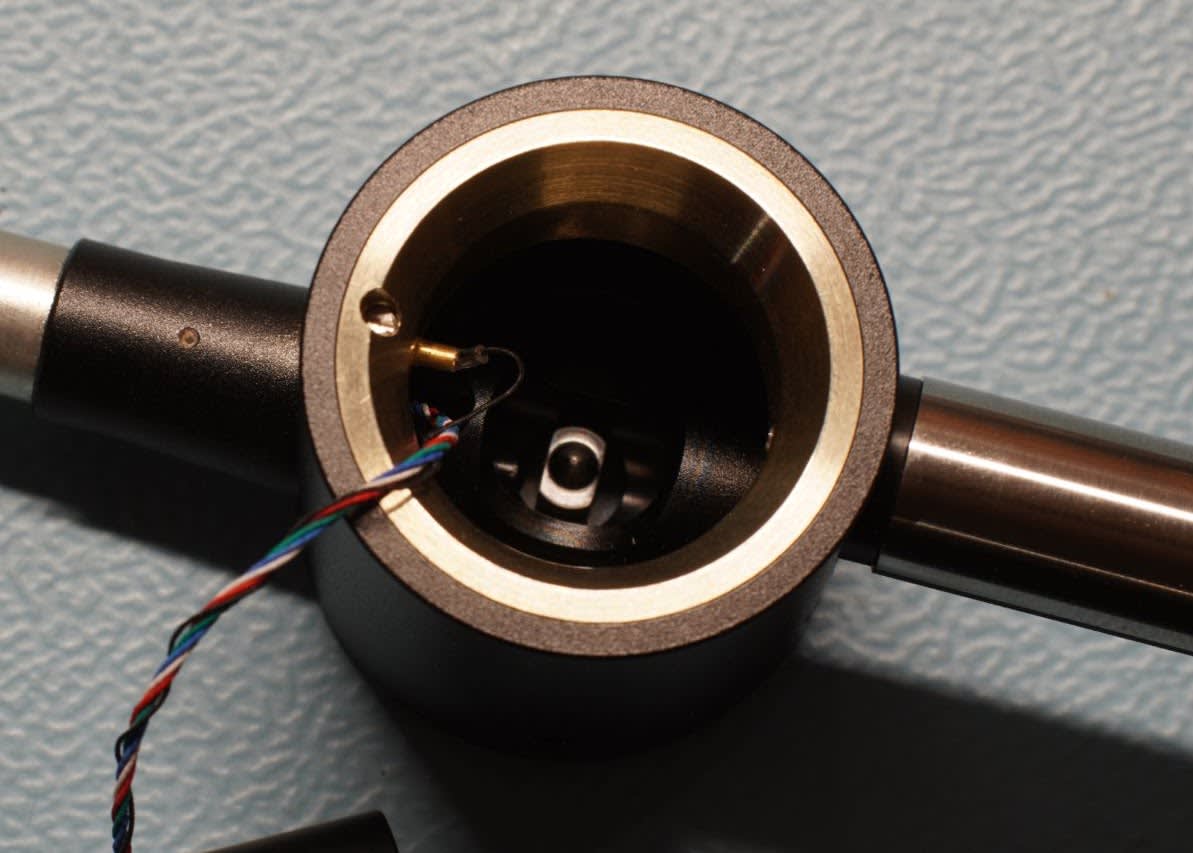
Hidden inside the lower third of the main body, a nickel silver balance weight is inset into the aluminium body, acting simultaneously as a balance weight, as the captive nut for the counterweight bolt, and as the grounding point for the main ground wire. One component doing three jobs, with no added complexity.
In-House Cueing
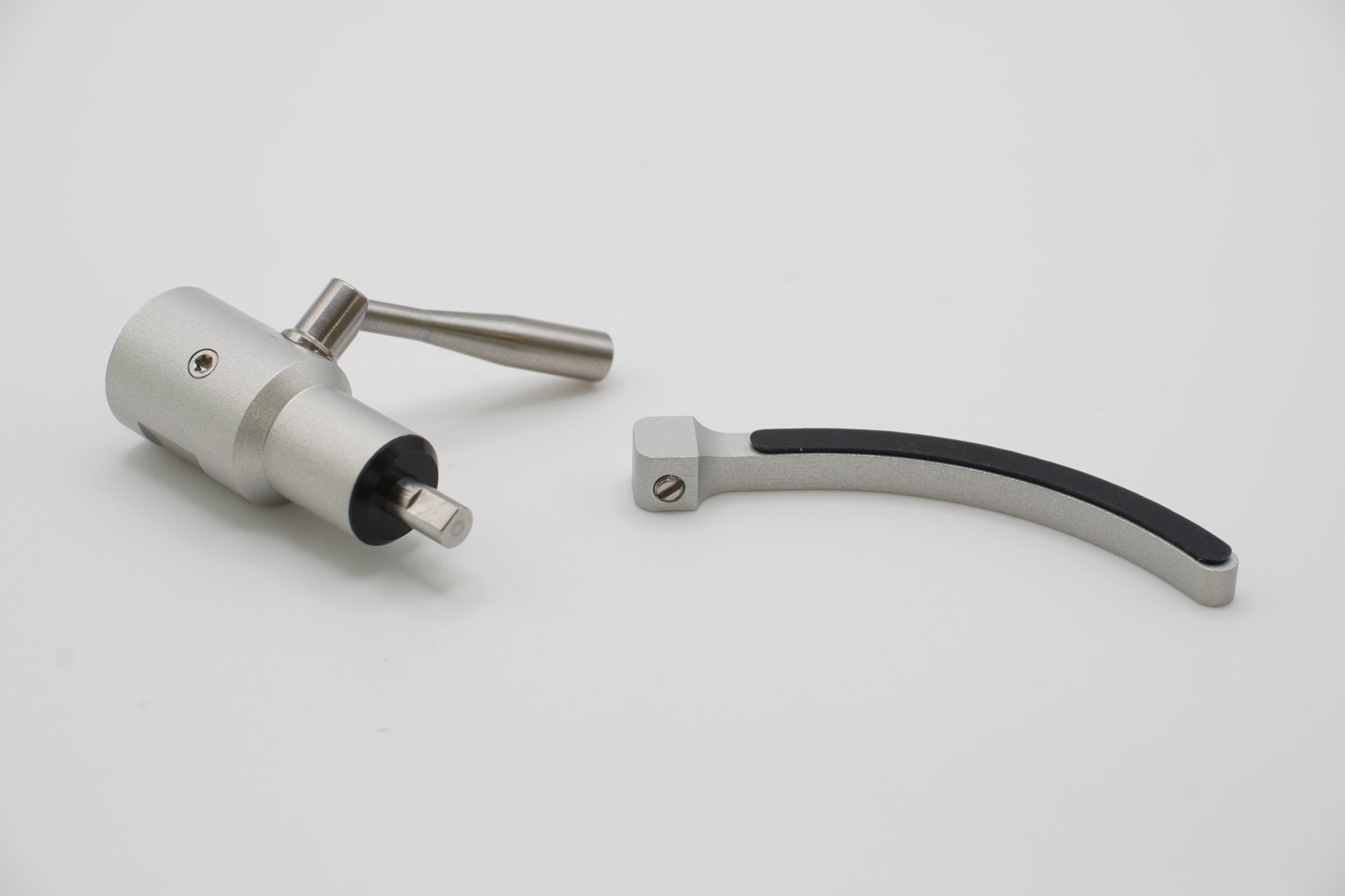
The cueing mechanism is designed and machined in-house, not bought in. That's deliberate: the lift is one of the hardest parts of a tonearm to get right. Ours lowers slowly and lands square every time, with no drift across the record.
Inside the arm mount
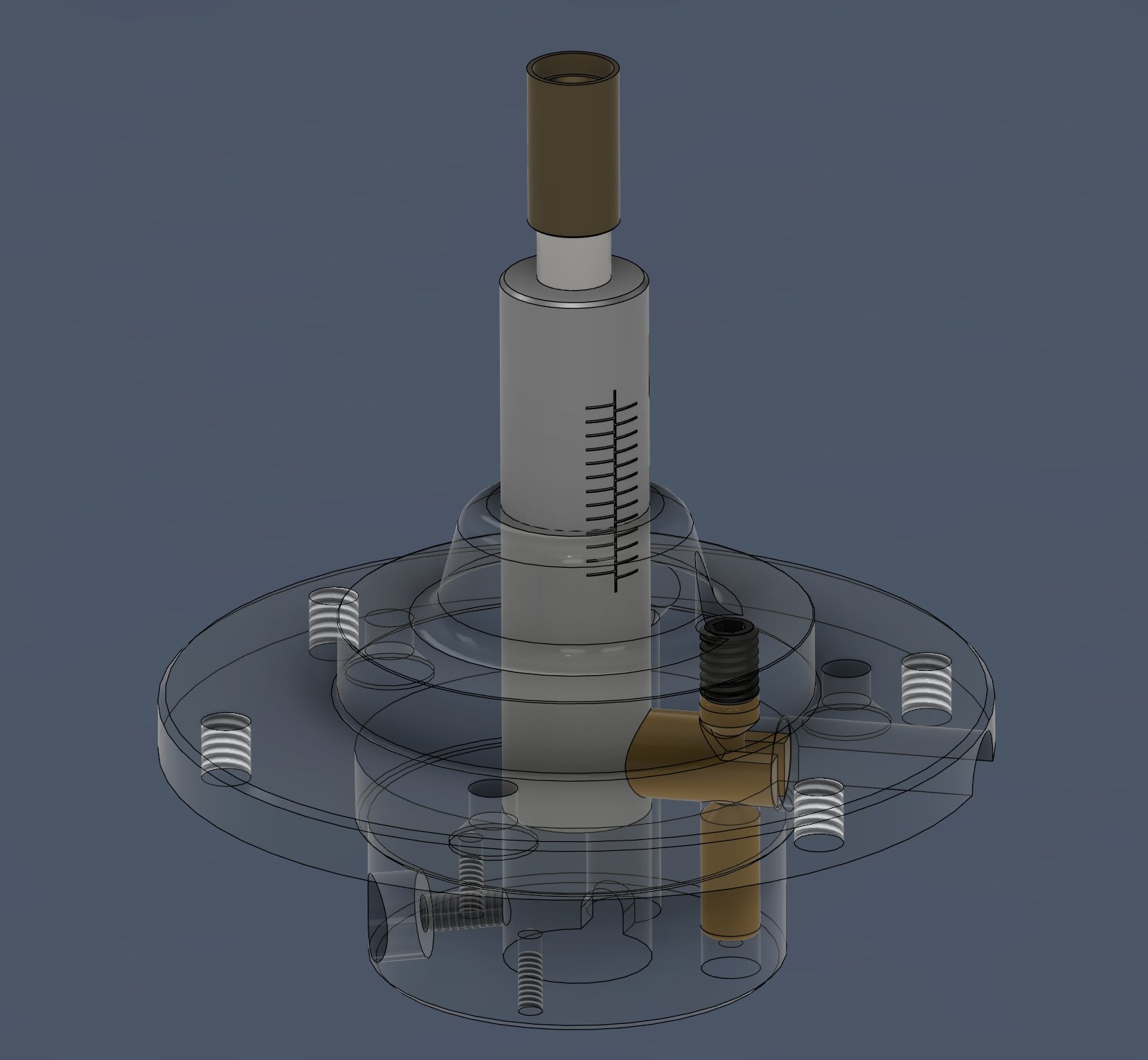
Bearing stack
Support screw
Ceramic sphere
Silver steel bearing support
Nickel silver sapphire housing
Sapphire cup
The VTA Clamping System
Most tonearms lock VTA with a grub screw bearing against a point on the support pipe. Effective, but crude. It marks the pipe, concentrates force at a single point, and requires awkward sideways access. The Clear Wave takes a more considered approach.
A hex screw accessed from directly above the arm drives a clamp actuator, which in turn applies lateral pressure through a support pipe clamp that locates against the pipe with a matching radius rather than a point contact. The clamping force is distributed evenly across the pipe surface, leaving it unmarked however many times the adjustment is made.
The result is a VTA adjustment that is cleaner to operate, kinder to the arm, and, with the support pipe engraved at 0.5mm intervals, genuinely repeatable. Note a setting, try something different, return to it exactly.
The arm pivots on the sapphire cup inside the nickel silver housing. The housing is attached to the silver steel bearing support, which rests on the ceramic sphere below. Two ultra-hard, near-frictionless surfaces isolate the assembly from the chassis. Both bearing materials are chosen for their exceptional hardness and corrosion resistance. Neither will wear measurably in normal use.
Alignment

The Clear Wave is set up for Baerwald alignment geometry, with null points at 66.0mm and 120.9mm from the record centre, giving the lowest average tracking error across the playing surface. Every arm ships with a custom alignment jig.
Plot the tracking error for the Clear Wave or any arm, or print our arc protractor.
Anti-skate
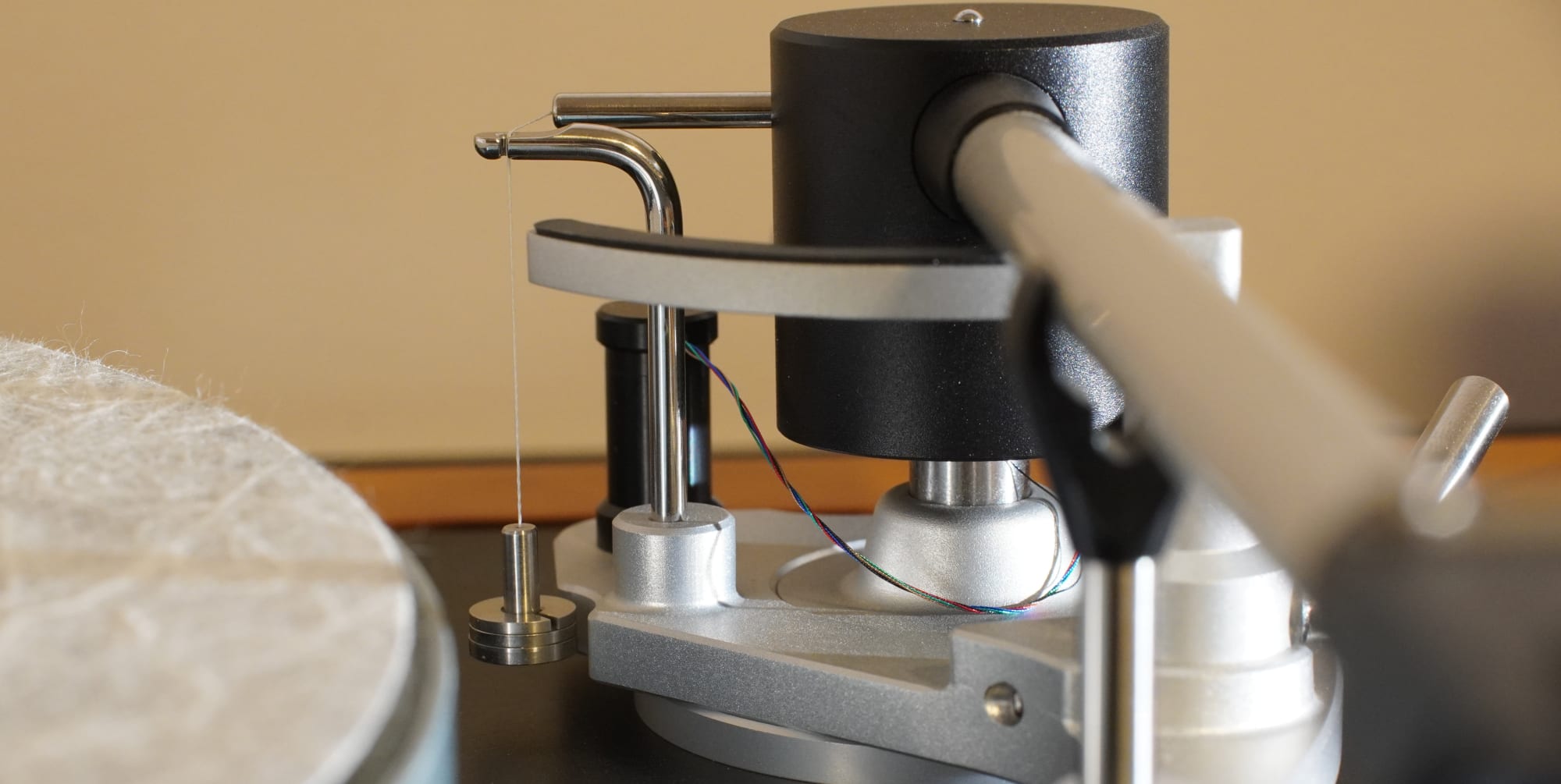
A thread-based anti-skate system, the same approach used in the original Naim Aro. A fine thread runs from the arm body over a support post, with a small weight providing the corrective force. No springs, no friction, no resonance.
Compatibility
Which cartridges suit the Clear Wave
An arm and a cartridge form a mass on a spring, with a resonance of their own. The target is 8 to 12 Hz: above the warp and footfall energy below it, below the audible band above it. Where a pairing lands depends on the arm's effective mass, the cartridge's own mass, and the cartridge's compliance.
| Clear Wave | 11 g | 10 to 22 cu |
|---|---|---|
| With the ceramic spacer | 14 g | 8 to 19 cu |
Compliance at 10 Hz that puts a 6.5 g cartridge inside the 8 to 12 Hz band. Your own cartridge's mass moves the window, so check the pairing.
The ceramic spacer
It is ceramic because ceramic is stiff. The joint between cartridge and headshell is the least rigid part of most arms, and the spacer is there to stiffen it.
It also weighs 2.6 g, and that mass lowers where the arm and cartridge resonate together. For a low-compliance cartridge sitting just above the band, it is often enough to bring the pairing in. On our figures the Denon DL-103R moves from 12.2 Hz to 11.4 Hz, which brings it inside the band. That pairing rests on a compliance figure converted from the maker's 100 Hz measurement, so treat it as an estimate.
And it adds height. A cartridge with a shallow body can leave the arm near the bottom of its height adjustment before the arm tube is where you want it, and the spacer gives that adjustment somewhere to go. At 1.5 mm it is worth 0.38° at the stylus, against 0.15° for the 0.6 mm between a standard record and a heavy pressing. Work height and angle both ways.
Fitting it is a judgement rather than a default. The same 2.6 g that rescues a stiff cartridge will push a compliant one already near the bottom of the band below it.
Guarantee & Serviceability
The Clear Wave is built to last and designed to be looked after. Bool Audio takes a right-to-repair approach, spare parts are available beyond the guarantee period, not just during it. Every arm is manufactured in Great Britain and guaranteed for two years against defects in materials and workmanship. This is a tonearm designed to still be in use in twenty years.
Manual & Support
The full Clear Wave user manual and assembly drawings are available to download at the bottom of this page. Bool Audio is happy to help with installation, setup, or any questions about compatibility. The Clear Wave is also available through our authorised dealers in the UK and Europe. Our UK dealer holds demo units for performance comparisons.
“The soundstage is incredibly large. Vocals are beautifully centered, warm, and full of detail. I am absolutely delighted and very happy to be working with this wonderful tonearm.”
Specifications
Dimensions
| Pivot to spindle | 211 mm |
|---|---|
| Cartridge fixing centres | 12.70 mm |
| Offset angle | 24° |
| Overhang | 18 mm |
Performance
| Null points (Baerwald) | 66.0 mm / 120.9 mm |
|---|---|
| Effective mass | 11 g (without spacer) / 14 g (with ceramic spacer) |
| Cartridge weight range | 6.5–9.5 g (with ceramic spacer) |
| Anti-skate | Adjustable weight system, 0.4 g increments |
| VTA adjustment | 0.5 mm graduated intervals |
Build
| Type | Unipivot |
|---|---|
| Arm body | Precision machined aluminium |
| Bearing support | Silver steel |
| Sapphire housing | Nickel silver |
| Pivot bearing | Sapphire double cup |
| Sub-pivot | Ceramic sphere |
| Ceramic spacer weight | 2.6 g |
| Cartridge mounting | Linn 3-point or standard 2-point |
| Turntable compatibility | Linn LP12, standard armboard |
| Internal wiring | Silk copper Litz |
| Output connector | Standard Linn connector |
| Finish | Anodised aluminium |
| Country of manufacture | United Kingdom |
| Guarantee | 2 years |
These figures describe the current production run. We revise them when a measurement is refined, rather than leave an old number standing.
The working behind the effective-mass figures is written up in Calculating the effective mass of the Clear Wave tonearm.