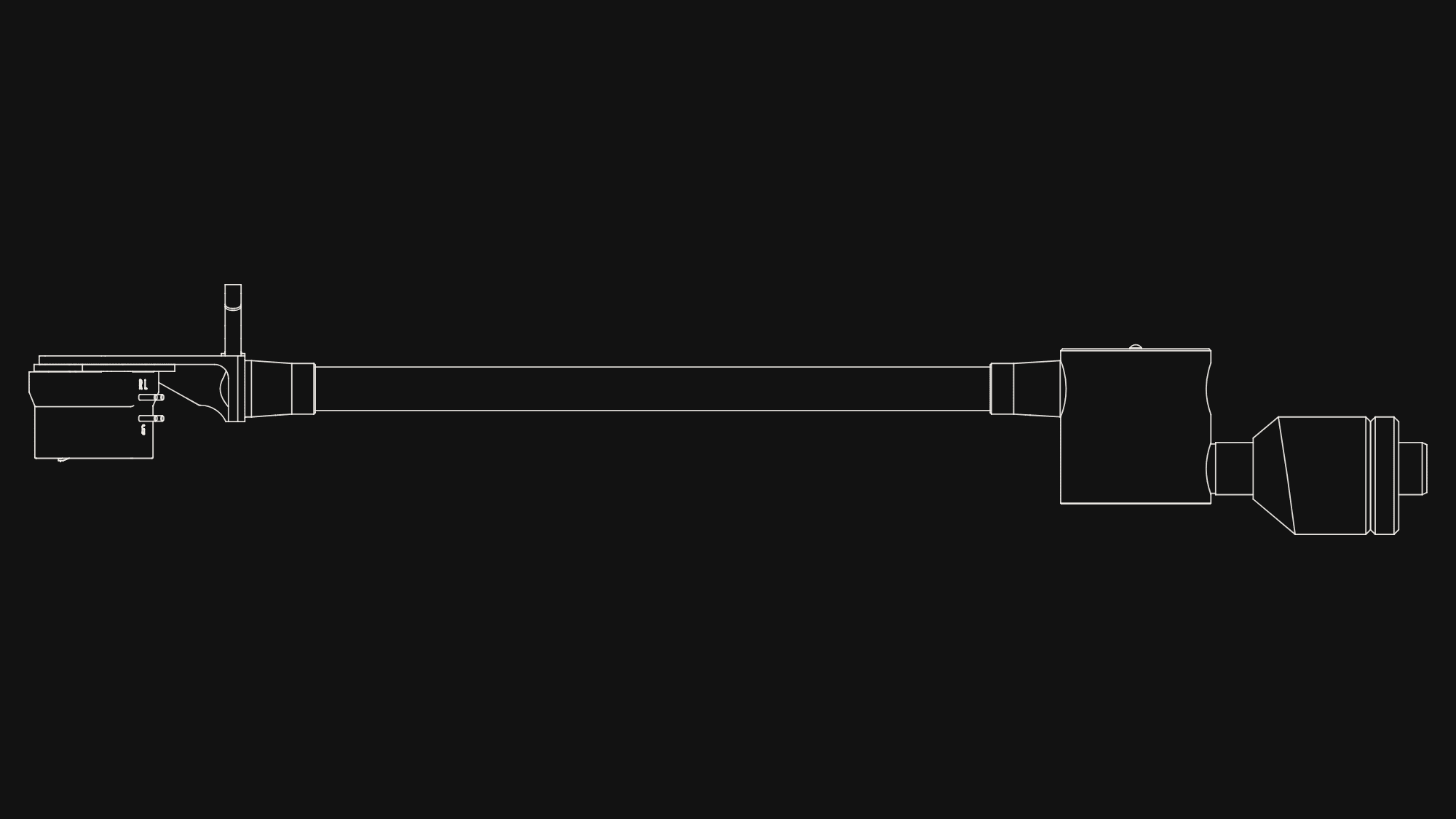
The Clear Wave's effective mass is 11.3 grams. Fit the ceramic headshell spacer and it becomes 13.7 grams. Clearly this is not the weight of the arm which weighs 176 grams. So why the effective mass, surely the mass of the arm is most important. Well it turns out that what is important is the mass of the arm as seen by the cartridge and their interaction, this is where the effective mass is important. This is what is needed to get an idea of how cartridges will work with tone arms.
This blog shows how we calculated the effective mass of our arm and its potential effect on cartridge choice.
Calculating the effective mass
When a tonearm moves it moves about a fixed point on the turntable using its bearing, so when the stylus rides a warp or the stylus tracks the groove it has to swing the whole arm with it. How hard that is depends less on what the parts weigh, than on where they sit in relation to the fixed point.
Think of a see-saw. A bag of sugar on the far end takes real effort to lift; the same bag sat next to the hinge takes almost none, in physics this is known as the moment of inertia and is calculated with the formula (see Eq.1)
We can see that the moment of inertia increases as the square of the distance from the point of rotation, so masses further away are harder to move, have more inertia.
We can then calculate the effective mass from the inertia using the formula (see Eq.2)
where \(L_\text{eff}\) is the distance from pivot to stylus. That's the number the cartridge feels.
To calculate the effective mass of the tone arm we need to do two steps.
-
Add up how hard every part is to swing about the pivot calculate, its moment of inertia.
-
Ask what single mass, sitting right at the stylus tip, would be equally hard to swing. That mass is the effective mass.
Calculating the moment of inertia of the arm.
In order to calculate the moment of inertia of the whole arm we looked at the arm as different parts and calculated the inertia of each part. The individual parts we chose were: arm tube, headshell, weight arm, counterweight and main body. We weighed each one, and noted the distance each one was from the pivot. This data was used for the calculation.
Using the counter balance weight and the Headshell makes for a good worked example. We can see the effect each part has on the effective mass of the arm.
Counter Balance Weight
To simplify calculations we model the balance weight as a point mass.
Counter Balance Weight:
\(M_\text{cb} = 81.2\text{g}\)
Distance to centre of mass:
\(R_\text{cb} = 42\text{mm}\)
\(\text {or in SI standard units}\)
Headshell
To simplify calculations we model the Headshell as a point mass.
Headshell Weight: \(M_\text{hs} = 8.2\text{ g}\)
Distance to centre of mass: \(R_\text{hs} = 200\text{ mm}\)
\(\text{in SI standard units}\)
From equations 3 and 4, we can see that the moment of inertia is greater for the Headshell than the Counter Balance Weight, a surprising result. It follows that the contribution to the effective mass of the arm is greater for the Headshell than the Counter Balance Weight.
From these results we can calculate the effective mass of these parts using Equation 2.
Calculating the effective mass of these parts
The distance from the pivot to the stylus point for the arm is the effective length, \(L_\text{eff}\).
Counter Balance Weight
Headshell
This shows that the Headshell has a bigger influence on the effective mass of the arm than the much heavier Counter Balance Weight.
We can calculate the other parts in the same way, the details are in an appendix if you are interested. The results are summarised in the table below.
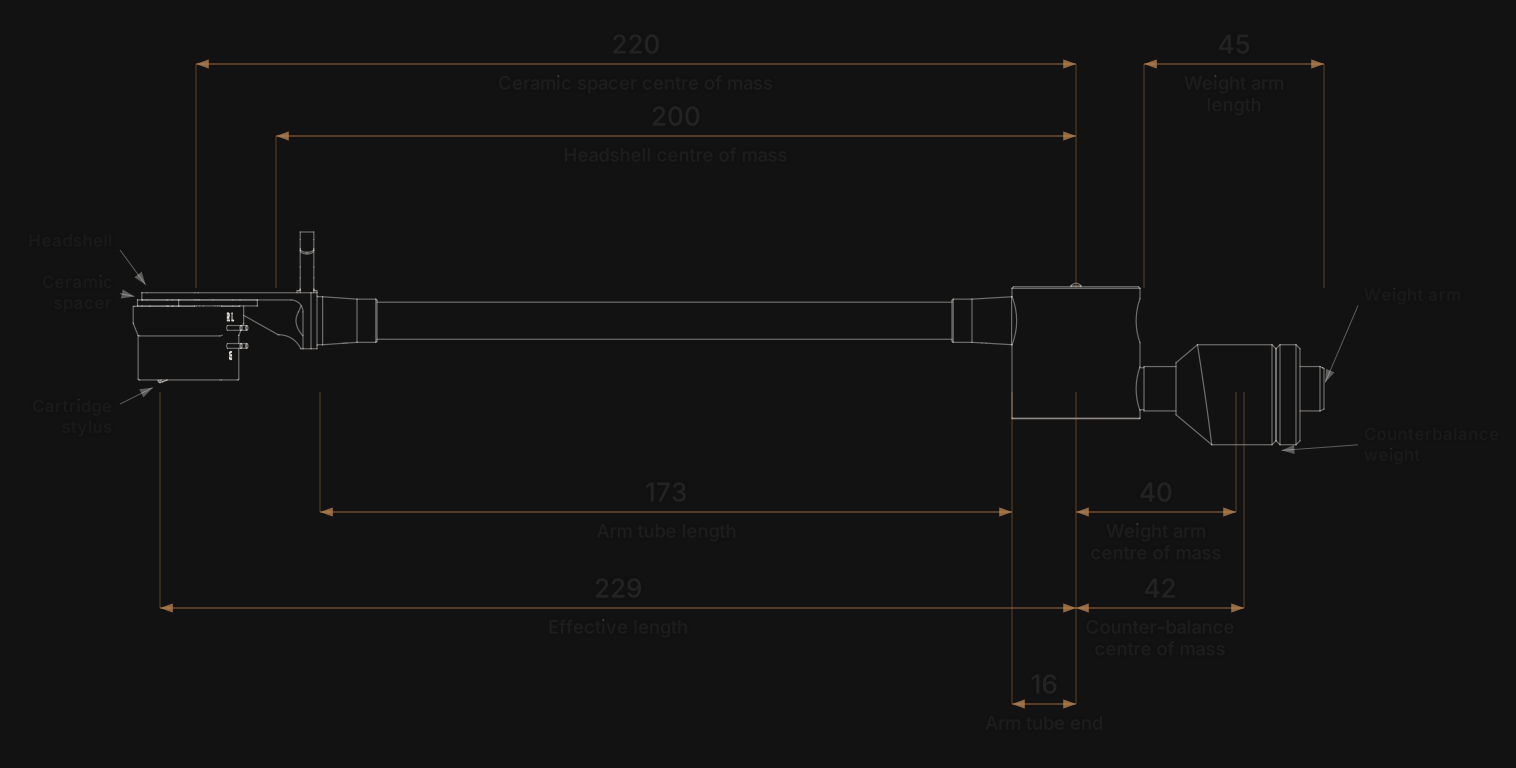
Each part's distance from the pivot
The results
| Part | Part Weight (g) | Effective Mass (g) |
|---|---|---|
| Arm Tube | 5 | 1.24 |
| Headshell | 8.2 | 6.25 |
| Weight Arm | 27.5 | 0.93 |
| Counter Balance Weight | 81.2 | 2.73 |
| Main Body | 54.25 | 0.13 |
| Total Effective Mass | 11.29 |
The total is worked out before rounding, so it does not quite match the sum of the column above.
Adding the ceramic spacer gives the Total Effective Mass as,
| Part | Part Weight (g) | Effective Mass (g) |
|---|---|---|
| Ceramic Spacer | 2.6 | 2.40 |
| Arm without spacer | - | 11.29 |
| Total Effective Mass | 13.69 |
Matching a cartridge
Effective mass matters because the arm and the cartridge's suspension form a resonant system, like a weight on a spring. Its frequency is:
with the masses in grams and \(C\) the cartridge's compliance in cu (compliance units). You want the result between 8 and 12 Hz: below the deepest music but above the frequencies of record warps and footfalls, so neither excites it.
To check a pairing for your cartridge you could manually do the calculation but on the Bool Audio website you will find a calculator and database of cartridges. If yours is not there choose a closely matching one or enter your values if known, these can usually be found on manufacturers websites.
If your own tonearm's effective mass was never published, you can work it out from a measured resonance rather than guess.
What we didn't model
The arithmetic treats the tube as a uniform thin rod and the compact parts as point masses. The bearing and the internal wiring aren't in there at all; they sit at the pivot, where mass barely counts.
Those simplifications might move the answer by a few tenths of a gram. That's fine. The number exists to match a cartridge, and no cartridge cares about the third decimal place.
Appendix 1
Calculating the moment of inertia and effective mass of the main parts of the tone arm
1. Arm tube
Moment of Inertia
The Arm Tube is modelled as a thin bar of mass \(M_{at}\) and length \(L_{at}\), with the centre of rotation shifted by offset \(S_\text{at}\) from one end using the parallel axis theorem. We don't need to account for the fact it is a thin walled tube as it makes almost no difference to the final result.
Effective Mass
2. Ceramic Spacer
Moment of Inertia
The Ceramic Spacer is modelled as a point mass at 220mm from point of rotation.
Effective Mass
3. Weight arm
The Weight Arm is modelled as a small cylinder (O/D=11.0 mm, I/D=4.0 mm), with the centre of rotation offset by 40mm.
Moment of Inertia
Inertia about the cylinder's own centre of mass is then shifted for the offset:
Effective Mass
4. Headshell
In main text
5. Counterbalance weight
In main text
6. Main body
The Main Body is modelled as a cylinder of mass \(M_\text{mb}\) and radius \(R_\text{mb}\)