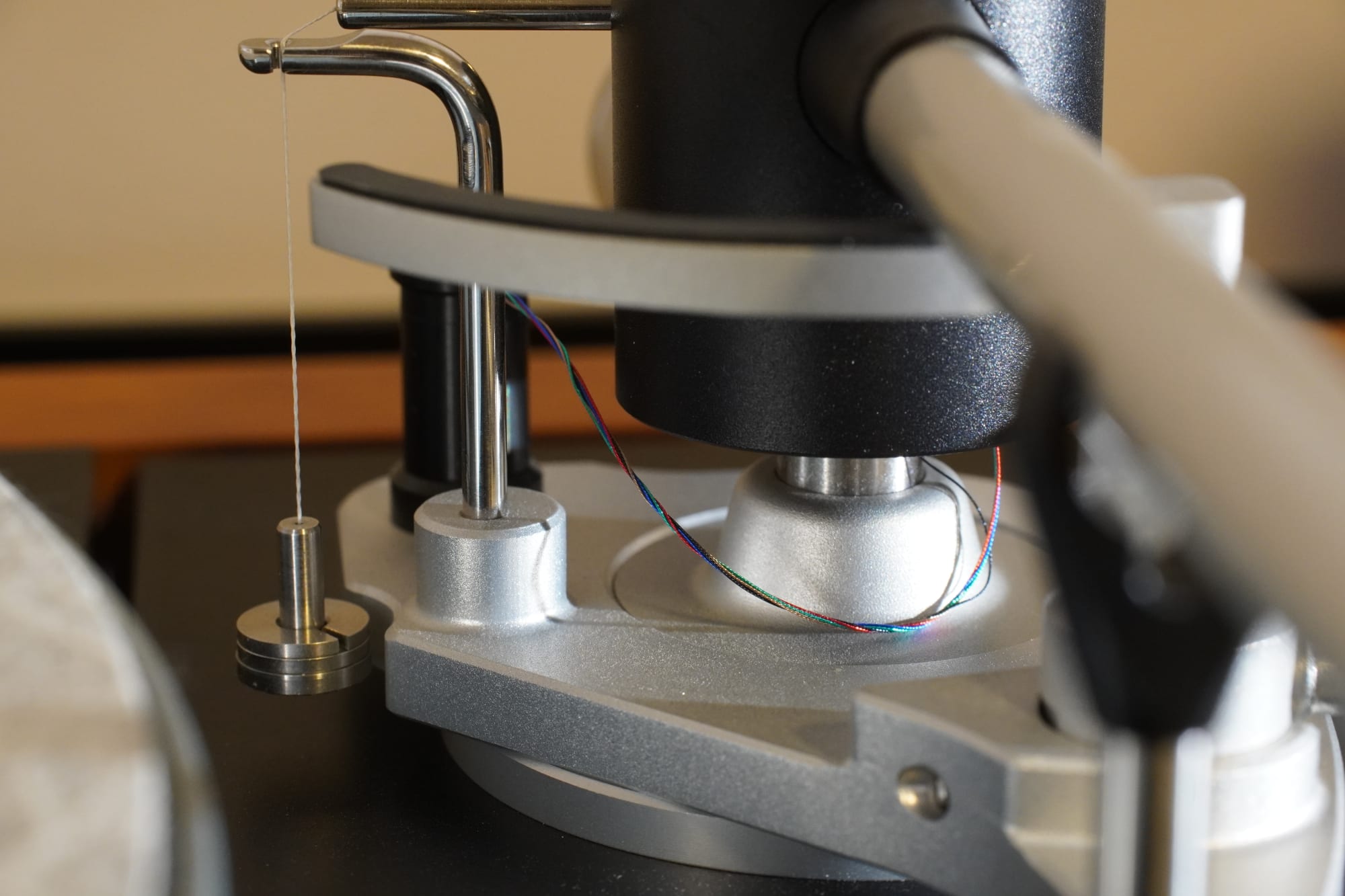
Silver-Plated Copper Litz Wire in the Clear Wave Tonearm
A moving coil cartridge puts out a few hundred microvolts. The first thing that signal meets is the tonearm's internal wiring, and every millimetre of it either preserves the signal or degrades it. In the Clear Wave, we offer Soundlink silver-plated copper litz wire as an upgrade over the standard silk-sleeved copper loom.
What the wire is
The conductor is high-purity copper litz: many fine strands, each one silver-plated and enamel-insulated, bundled under a coloured outer sheath to a diameter of around 0.4mm. The core is Estron wire, developed for hearing aids and in-ear monitors, where microvolt signals and constant flexing are the normal working conditions. Soundlink supplies it pre-tinned, in 10m packs, colour-coded for channel identification.
Key specs
- Conductor: high-purity copper, silver-plated on each strand
- Construction: litz, 7 strands of 0.05mm wire; individually enamelled strands, double enamel, plus outer jacket
- Outer diameter: around 0.4mm
- Supplied: pre-tinned, 10m packs, coloured sheaths

Soundlink wire on 10m wrap cards showing colour coding
Why litz construction suits a unipivot
At high audio frequencies, current crowds toward the surface of a conductor and away from neighbouring conductors: the skin and proximity effects. Litz construction splits the conductor into many individually insulated strands so more of the copper carries current, and silver plating raises conductivity at the surface, where the crowding happens. Over the short run inside a tonearm the result is low resistance and low inductance.
The mechanical property matters at least as much in a unipivot. The arm balances on a single point, so any stiffness in the wiring acts as a restoring force working against the bearing. At 0.4mm overall, the Soundlink bundle flexes under its own weight; routed with slack, it leaves the arm's float alone.
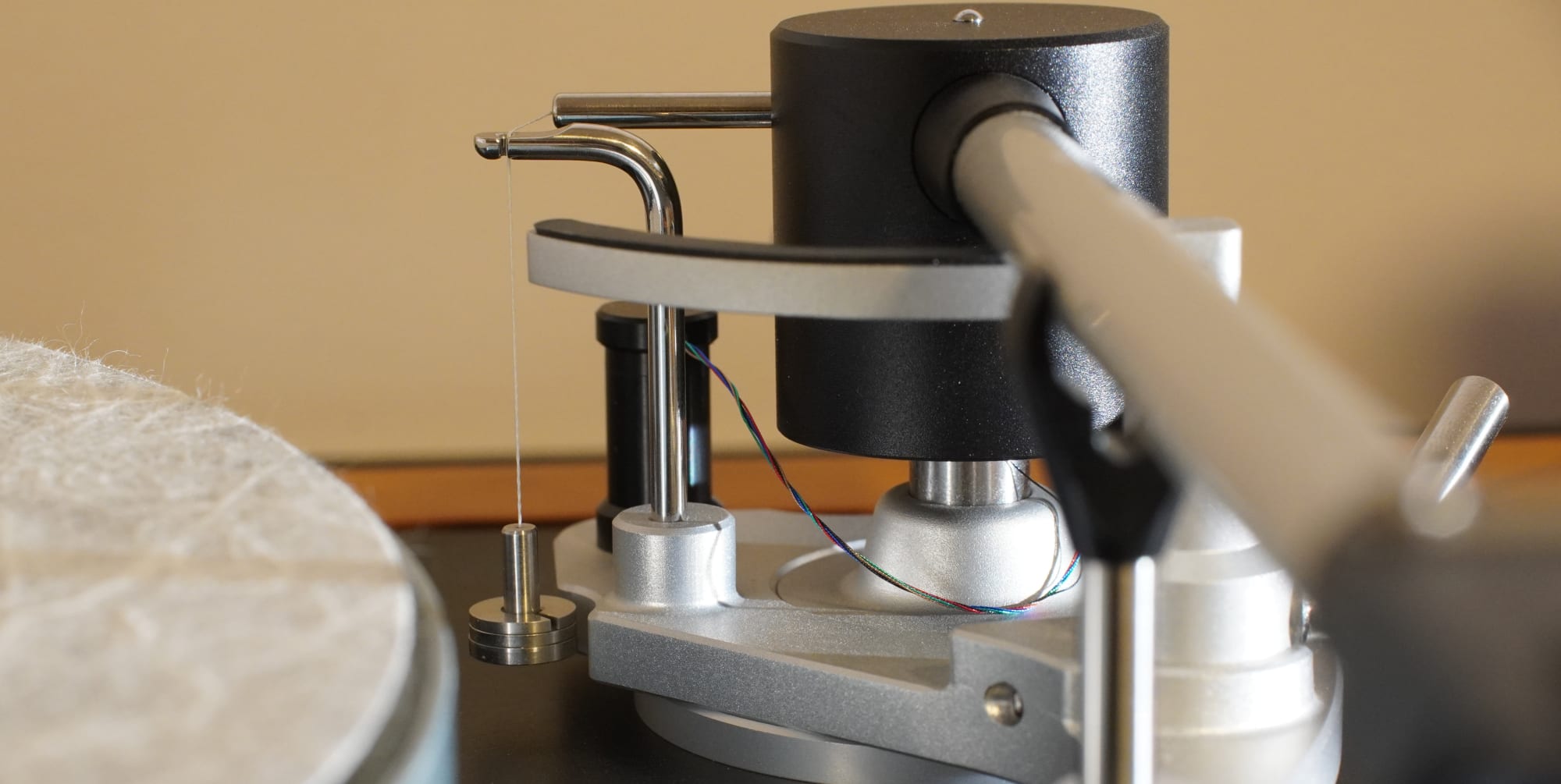
Close-up of Soundlink wire in the Clear Wave, highlighting the fine supple construction
Soundlink vs. silk-sleeved copper litz
Many tonearms use enamelled copper litz under a silk or textile sleeve. The silk adds mechanical damping, and some listeners like the slightly soft, forgiving character that comes with it.
The Soundlink loom trades that give for control. Silver-plated strands under modern enamel give better surface conductivity and a tighter, more stable geometry, with less mechanical movement inside the bundle. The result is a more immediate, explicit sound with closer matching between channels. The trade-off is that it's harder to install than a silk-sleeved bundle.

Close-up of wire highlighting the proprietary micro DIN connector
How it's installed in the Clear Wave
The Clear Wave is a robust tonearm. The internal wiring is not: the enamel insulation is thin, and a sharp bend or a hot iron damages strands you can't see. The installation is built around that.
- The wires are routed with gentle curves and enough slack that the arm's movement never stretches or compresses the bundle
- Solder joints at the cartridge tags are kept short and low-heat to protect the enamel and fine strands
- The wires are enclosed in PTFE tubing at the cartridge tags, with the tags crimped onto the tubing to act as strain relief
Handled roughly, the loom repays you with micro-crackle and intermittent drops in output. So the routing is done once, carefully, and then left alone.

Close-up of the PTFE tubing reinforcing the delicate wires at the headshell
What the upgrade sounds like
Against the standard silk litz, the first thing we hear is a lower noise floor: less hum and hiss, most obviously in the quiet between tracks. Low-level detail and the space around instruments come up with it, and bass is tighter and better defined. The overall character is more immediate and open than the silk-damped loom.